Ultimate First Draft Checklist: Secrets to Bestseller Success

Are you in the process of writing your first novel? Have you taken part in NaNoWriMo this year? Do you have a first draft written and ready for the next stage?

🎉That’s fabulous!  🎉 You’re at the perfect stage to take advantage of my Ultimate First Draft Checklist 

👇 Keep Reading 

You’re a new writer wanting to get your story published. I understand how overwhelming it is to have so many answers available at the end of a google search. There are a never-ending supply of people offering new writers and indie authors advice about what the rules of the wordsmith are. Some even seem to contradict one another!

confused young ethnic female having video conversation on mobile phone at home
Photo by Alex Green on Pexels.com

And that’s the thing, as a qualified editor myself and self-confessed bookworm, I’ve learned that these often touted rules are in fact only guidelines and opinions; they shouldn’t be followed blindly.

What’s next?

I wrote a post showing you the 4 steps to do After You’ve Written a Book and what tasks can be left for now. With that in mind, my Ultimate First Draft Checklist should be used when you assess your manuscript in step 2.

Before you jump into editing mode, read your book from start to finish. This is the second step in gaining perspective on your book. While it is time-consuming, it’ll save you countless hours in the long run because you’ll see exactly what you need to work on for your next draft.

As you read, ask yourself the following questions and take notes about what you find:

  • What’s missing?
  • What isn’t needed?
  • Which bits need rewriting?

In my Ultimate First Draft Checklist, I cover the 6 core aspects of any story:

  • Opening Scene/First Chapter
  • Characters and Dialogue
  • Plot and Conflict
  • Flow and Pacing
  • Setting and World-building
  • Writing Style

The questions on my checklist ultimately get you to answer the big question: Is my manuscript a best seller?

I understand that this step can be both exciting and a little terrifying. But I promise you, it is worth it!

…are you ready?

Receive my Ultimate First Draft Checklist now and start honing your story today!

[mailerlite_form form_id=9]

For more helpful resources about the craft of writing, check out my Resource Library.

What to Do After You’ve Written a Book

You worked hard on your book baby. 💙 Staying up late, getting up early, pushing through writer’s block, and finally, you’ve finished. You’ve written a book! Congratulations! 🎉

And now breathe…

But, now the questions start hounding you. Beginning with, “I wrote a book! Now, what?”

I’ve created 4 simple steps to follow that lead you through the next part of the process.

What Do You Do After You’ve Written a Book?

girl in blue shirt sitting on brown wooden chair
Photo by cottonbro on Pexels.com

If this is your first book, or the first one you’ve actually finished, I’m sure you’ve got a hundred and one questions clamouring for answers.

Do I look into self-publishing?

Maybe it’s time I look for a literary agent?

Should I hire an editor to double-check my formatting?

Do I have to do all of this to get my book out there?

All of these questions are important parts of the writing and publishing process. However, you don’t need to do all of them right away.

In this article, I’ll break down the next steps you should focus on now (and which ones you could forget for a while, or not bother with at all).

As you’ve probably guessed, when you finish writing your book, you’re not actually finished. Sorry.

woman leaning on table
Photo by Andrea Piacquadio on Pexels.com

In fact, finishing your book is just the beginning. And if this is your first time, you’re probably looking for advice on what to do next.

In this post, I’ll cover what comes after you write a book.

But before we talk about what you should do, let’s talk for a moment about what you should avoid after writing your book.

First, What You Shouldn’t Do After You’ve Written a Book

fashion people woman girl
Photo by Karolina Grabowska on Pexels.com

New writers are usually eager to send off their books or short stories as soon as they finish writing. However, very few—if any—finished books are good books after a first draft.

For this reason, the first step you take after finishing a book is not to announce you’re done on social media 📣 before quickly heading to Kindle books or Amazon to self-publish it. Or is it rushing off to a publishing house or literary agency in search of representation. ⛔

There’s still work to be done!

You’re going to want to make some revisions before that first attempt, even if it’s a decent first draft, becomes a great book.

In a nutshell, here’s what to avoid after you write a book—for now.

Don’t send your book to a publisher.

Good writing is rewriting. If you want to get published, don’t send your book to any of the following people yet:

  • Agents
  • Acquisitions Editors
  • Publishers

Submitting your manuscript before it’s ready could lead to permanently burning a bridge. Some literary agents even have a policy that rejection of a manuscript is a rejection from the agency as a whole.

This is why literary agents will openly encourage writers to participate in programmes like NaNoWriMo, but also politely ask them to not send their manuscripts to them as soon as November ends.

Revising Needs to Happen First!

I know you’re excited about sharing your hard work, but there’s still a lot to do.

Don’t send your book to beta readers.

Beta readers, are people who read your book and give you feedback before you publish. Good beta readers can help transform your manuscript from mediocre to excellent.

However, beta readers are best used after you’ve worked out some of the kinks in your manuscript on your own first. Or else, you might get feedback that you’re not ready for, or that hurts your self-confidence as a writer.

We’ll talk about the best time to send your story to beta readers in a moment.

Don’t edit your book.

What most people do after they finish their book is going back to page one and start line editing from the beginning; fixing typos, correcting grammar, and polishing sentences until they shimmer.

This is a huge mistake.

Here’s the problem: after you finish your first draft, there’ll be major structural issues. There are going to be sections that need cutting, other sections that need to be written from scratch, and others that need replotting.

What happens when you realise you have to cut a section that you’ve devoted hours, or even days polishing? At best, you’ve just wasted a heck of a lot of time, and at worst you might be tempted to “just leave it in” because of the time you’ve spent on it.

Instead, I have a better system that will save you time and result in a better book at the end of the process.

Next Steps After You Write a Book

positive businesswoman doing paperwork in office
Photo by Andrea Piacquadio on Pexels.com

Now that you know how to avoid the dangers, let’s talk about what you should do next after you’ve written the book.

I recommend these four steps.

1. Let Your Book Rest

What to do after you've written a book - Step 1. Let your book rest (1)

Not only do you need a break after you’ve written the book, but your book also needs one too.

This is because after you’ve finished writing, you have no perspective on it. You’re too close. You won’t have the objectivity to know what works well, what should be cut, what needs work, and what is fabulous and should be left alone.

Letting your book sit for a few weeks, even a month, gives you time to regain perspective and start to see your book for what it is — or what it can become.

If taking a break is hard for you, remember that working on your book doesn’t mean you have to stop writing or growing as an author.

If you’re feeling antsy, head out to your favourite coffee shop. Brainstorm new book ideas. Read your favourite published author’s books. Lose yourself in the latest bestseller. Listen to your favourite podcasts on writing.

If you want to see your whole book for what it is, you need to spend enough time away from it before picking it up again, this time with fresh eyes and a clear head.

2. Read Your Book

What to do after you've written a book - Step 2. Read your book from start to finish

Before you jump into editing mode, read your book from start to finish. This is the second step in gaining perspective on your book. While it is time-consuming, it’ll save you countless hours in the long run because you’ll see exactly what you need to work on for your next draft.

As you read, ask yourself the following questions and take notes about what you find:

  • What’s missing?
  • What isn’t needed?
  • Which bits need rewriting?

I understand that this step can be both exciting and a little terrifying. But I promise you, it is worth it!

3. Edit and Rewrite for Structure

What to do after you've written a book - Step 3. Edit and rewrite for structure

Now that you have a good idea about where your book is and where you want it to go, you’re ready for the second draft.

This is when you write new sections for those holes you found when you read through your draft. It’s when you cut those sections that weren’t necessary, and when you rewrite the sections that were needed but weren’t quite right.

Your second draft isn’t about fixing typos and polishing sentences. It’s about structure.

This part can feel like sculpting, chiselling away at your book trying to discover the treasure hidden in the unsophisticated, hulking block.

Once the overall structure of your book is sound, only then should you start to polish it.

Depending on your comfort level, you might decide you can do this with self-editing. If you’re less sure, don’t be afraid to reach out to a developmental editor for direction and advice.

4. Get Some Help

What to do after you've written a book - Step 4. Get some help

It’s a good time to start inviting other people into your book once you got your second draft, this includes critique partners, beta readers or even an editor.

Before this stage, your book isn’t you enough. Getting too much involvement from other people after a first draft may cause your book to get lost, to lose some of your vision. The second draft allows you to put more of yourself into your book.

It can be hard to tell when your book is done, which is why it’s so important that you find a writing community and critique groups that can push you through not one, not two, but at least three revised drafts. The more revisions the better.

And finally…

Only then, when your manuscript is the best it can possibly be, should you consider your publishing route.

Traditional or self-publish?

photo of pathway surrounded by fir trees
Photo by James Wheeler on Pexels.com

If you hope to pursue traditional publishing, your next steps will involve tackling the submission process.

The jobs needed here include:

  • Researching literary agents
  • Writing query letters
  • Writing a synopsis (a synopsis is NOT the book’s blurb)
  • Contacting your list of dream literary agents

If, on the other hand, you want to self-publish your book, the next steps will include tasks such as:

  • Editing the book to a professional level
  • Get an eye-catching cover design
  • Formatting the inside and outside for publication
  • Market the book to drum up sales pre and post publication

Taking the time to assemble a good team that can help you take your book to the next level will give you the tools to be on a level playing field with the bestselling authors in your genre.

💡You’ve written a book – my final tip

You’ll spend a lot of time “waiting to hear back” during the publication process, whether you’re going down the traditional route or taking the plunge and self-publishing your work.

Precious writing time shouldn’t be wasted by sitting back and not doing anything. You can always do something you’re waiting for a stage to be completed. Take the time to think about what your next book is going to be. Start plotting. Make notes. Start writing!

Have you written a book? Do you have a published book out at the moment? Have you survived the submissions process? 😂 How did it feel?

Let me know in the comments!
Secret to Bestseller Success for Indie Authors

Do you know what the Secret to Bestseller Success for Indie Authors is? Have you ever wondered how one self-publishing author manages to write their books so successfully over another? 🤔 Well ponder no longer, dear writer, for I know one of their secrets and I’m going to share it with you today. 🤫

The indie author field has blossomed.

With the explosion of the self-publishing revolution, more and more of us are getting our stories out there. Trouble is, there are a growing number of helpful writing guides out there too. Each guide telling you the rules and how you should write!

adult blur books close up
Photo by Pixabay on Pexels.com

I understand how overwhelming it is to have so many answers available at the end of a google search. Many so-called rules of writing seem to contradict one another! It extremely frustrating. 🤷‍♂️ And that’s the thing, as a qualified editor myself, I’ve learned that these frequently quoted rules are actually more like guidelines and shouldn’t be followed blindly.

Language guidelines were (and still are) created to help readers understand the text they’re reading; following these guides should help bring clarity to a piece of writing not stamp out an author’s voice. Good editors understand this and pass that on to their clients.

So, here’s the secret to bestseller success…

…are you ready?

Hone your own author voice and create your own style guide!

Simple, isn’t it?!

With your own style guide, everything in your book will be clear and consistent. For example:

✅ When you write a character’s name, it will be spelled the same way through the story.

✅ When one of your characters is sharing their thoughts with the reader, it will be formatted identically each time. It becomes easier to distinguish from the spoken dialogue.

You get the gist.

I’m not saying abandon all spelling, punctuation, and grammar conventions, 😘 instead work with your editor to find the styles that fit with you, your stories, and your readers.

I collaborate with my author clients to create a style guide for their books as part of the editing process.

“After bathing in a sea of vaguely conflicting advice online regarding punctuation, I emerged with one clear message: there are no Actual Laws in force.  (—Author Holly Bell)

The good thing is, once you’ve got all these little “styles” agreed, it’s makes things easier in the future — for both you and your editor.

Start creating your style guide today and enjoy some bestseller success as an indie author yourself!

From now until 27th August 2022, I’m giving away How to create your Author Style Guide. My guide also comes with a free template. Start your new stress-free writing today!

[mailerlite_form form_id=9]

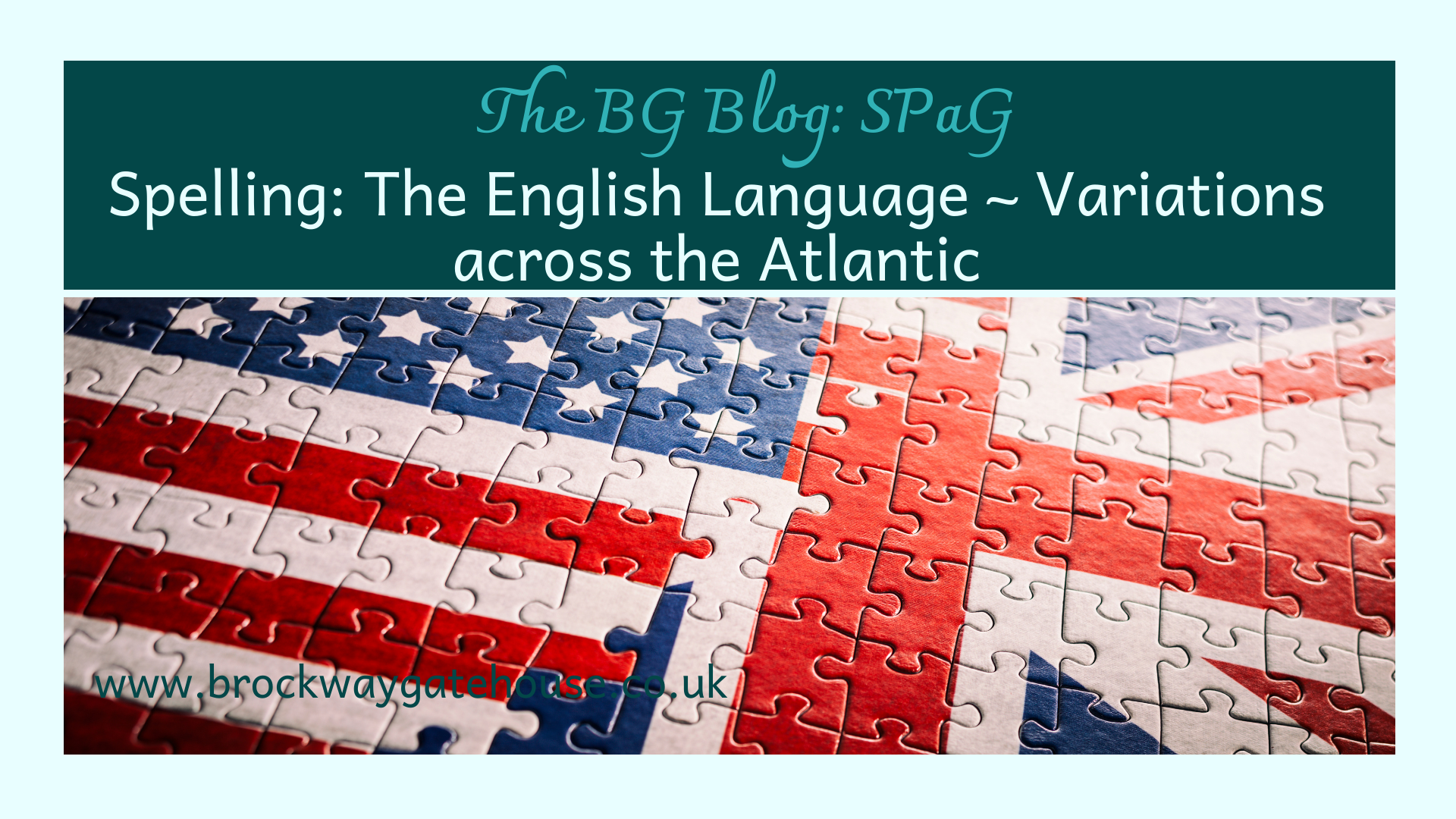
SPaG: Spelling The English Language ~ Variations across the Atlantic

Hello and welcome to the blog. It’s undeniable that the English language is tricky to master. I’ve already talked about the pitfalls when it comes to spelling. Today, I’m talking about the English language: variations found on both sides of the Atlantic.

The majority of my clients are British, however, I’ve worked with Canadians and Americans too. One of the first questions I ask a client before starting work on their manuscript is where they’ll be marketing their book? In other words, who is their target audience?

wood art dirty broken
Photo by Lara Jameson on Pexels.com

This decision will impact which version of English the novel should be written in. Today, I’m just going to look at the difference between English spellings in Britain and America.

BRITISH or AMERICAN ENGLISH

Please note that I use British English throughout this website. But what are the differences? Try these.

BRITISHAMERICAN
center
litre
humour
labor
neighbour
analyze
traveling
fueling
leukaemia
maneuver
pediatric
defence
offense
catalogue

How did you do? A couple of these have me reaching for my trusty Oxford English dictionary embarrassingly frequently.

You may be wondering why we live next door to neighbours, while our friends across the pond have neighbors. Or why our sky is grey, while theirs is gray.

The simple answer is:

Here are a few other differences to take notice of:

  • Words that end in a vowel and an “l”: in American English, “travel” becomes “traveled” or “traveling”, but, in British English, it becomes “travelled” or “travelling”.
  • The vowel combinations of “ae” or “oe”: in American English, they’d write “maneuver”, but on this side of the pond it’s “manoeuvre”.
  • Words that end in “-ize” or “ization”: using a “z” rather than an “s” is sometimes acceptable in British English.
  • Universally Americanised words: in British English, you program your computer but you still watch a TV programme.

How do these variations affect me?

I’m a self-confessed bookworm. While I’m reading, the differences between American spelling and English spelling jump out of the page. However, if the story is written by an American author my brain takes those variations in its stride as being part of the world-building and setting.

Therefore, when writing your own novel, consider your target audience. Are you looking to break into the American marketplace or here in the UK?

Once you’ve decided where your target audience live, you can make sure the spelling in your novel is consistent. We all use spell check programs. But remember to check what English variation your computer’s program is set to. Is it UK English or American English? While you shouldn’t rely solely on an automated program to find errors if whatever you use isn’t set to the English you are working with, the suggestions and corrections you see won’t be appropriate.

miniature toy robot on top of laptop s keyboard
Photo by Kindel Media on Pexels.com

I hope this post has helped. Which variations catch you out the most? (It’s okay — we’re all guilty of at least one.) Make a mental note to avoid those slips in the future, or just bookmark this page to remind yourself of them over and over (and over) again.

English, like many other languages, has its own set of tricky rules and intricacies. But with a little bit of practice and help from guides like this one, you can become a grammar master. I found a couple of fun (tongue-in-cheek) quizzes to try. They certainly put a smile on my face!

Buzz Feeds – American Vs British Words Quiz

Macmillan – British and American English Quiz

Thank you for visiting and taking the time to read The English Language: Variations across the Atlantic. If you have any tips or tricks to help you remember which spelling variant to use, drop me a comment below.

Until next time,

Kim

Pinterest Pin - The English Language

SPaG: Spelling – Solutions For Those Words in English That Always Trip Us Up!

It is a well-repeated mantra in schools and authors’ circles that English is a confusing language to master. Many of the “rules” of spelling and grammar have more exceptions than inclusions! Even after my many years in education, there are some that cause me to pause and reach for my reference books.

I’ve decided to write a few blog posts about spelling, punctuation and grammar. I’ll highlight some of the more common mistakes that turn up in the big wild world of publishing and show you how to avoid them.

Let’s start with spelling.

A boy was once told off by his teacher for misspelling a word. “You should have looked it up in the dictionary,” she told him.

He replied: “Why would I look it up if I didn’t know it was spelt wrong?

Not only does this have me giggling but it’s an important point. It’s easy for little spelling and grammar mistakes to slip by, especially when you’re self-editing. One of the points that were continually emphasised during my proofreading and editing training was to check every single word, even if it looks right.

Don’t have the time to read this post now? Pin it and read it later.

📌 Pin this post for later 📌

Pinterest Pin - SPaG Spelling Solutions For Those Words in English That Always Trip Us Up!

Good, you’re still with me.

There are more and more talented storytellers taking the bull by the horns and going down the self-publishing route to get their books out there.

Look at these common words listed below, which ones do you think are spelt correctly?

accommodateaccomodate
apparantlyapparently
appearanceappearence
assassinationassasination
bizarrebizzare
calendercalendar
cemetarycemetery
colleaguecollegue
completlycompletely
consciousconcious
curiositycuriousity
dilemnadilemma
dissapeardisappear
dissapointdisappoint
existenceexistance
forseeableforeseeable
fourtyforty
gistjist
glamourousglamorous
harassharrass
humouroushumorous
idiosyncrasyidiosyncracy
incidentlyincidentally
independantindependent
interruptinterupt
irresistableirresistible
liaiseliase
millenniummillenium
noticeablenoticable
occasionocassion
occurrenceoccurance
persistantpersistent
posessionpossession
preferredprefered
propagandapropoganda
recievereceive
resistanceresistence
seperateseparate
seigesiege
succesfulsuccessful
supersedesupercede
tattootatoo
tendencytendancy
threshholdthreshold
tonguetounge
unforseenunforeseen
unfortunatelyunfortunatly
untiluntill

Thankfully there are some excellent online dictionaries available. While I was training, I used Collins Dictionary Online to check EVERYTHING.

Techniques to improve your spelling

Here are some tips that will help you to keep your spelling up to standard:

  1. Use a small dictionary or an online one such as http://www.collinsdictionary.com/ or a smartphone app. Refer to it frequently: if in doubt, check.
  2. Keep your own “dictionary” on your PC or device or in a notebook or both. List the words that trip you up, A – Z.
  3. Practise your weak spellings. Write them down repeatedly until you know them.
  4. Check the spelling in everything you write, including email messages and social media posts. This will develop accuracy and improve your spelling.
  5. Use a spell check (most word-processing software packages have them) but never rely on them completely. They will pick out obvious errors but not mistakes like using “toe” instead of “tow”.

One of the statements I hear most frequently from new writers when talking about the pitfalls of spelling is:

But I don’t need to check my spelling with a dictionary, word does it for me

Yes, a spell-checking program is a lifesaver. I use one ALL THE TIME! 😉 However, it wouldn’t necessarily pick up a homophone error such as “hear” instead of “here” as I have already mentioned above. Also, make sure which language the program is set to. Is it UK English or American English? If it’s not set to the correct English language variation, you’ll miss some subtle but crucial spelling differences which I cover in The English Language: Variations across the Atlantic.

I hope this post has helped. Which common spelling mistakes resonate with you the most? (It’s okay — we’re all guilty of at least one.) Make a mental note to avoid those mistakes in the future, or just bookmark this page to remind yourself of them over and over (and over) again.

Here are some good interactive spelling tests. Try them and see how you score.

How To Spell – Tests

The Telegraph – Spelling Quiz: How good are you?

The Guardian – Quiz

Until next time,

Kim

📌 Pin this post for later 📌

Pinterest Pin - Spelling - Common Words (1)